Spelt

Spelt is not, as I first thought, gluten free and therefore not suitable for coeliacs but can be eaten by those with a more mild sensitivity to wheat. It is a subspecies of the closely related common wheat and has become popular and widely available in the past few years. Sharpham Park in Somerset have been working to recover the popularity of the age old grain. Spelt is their main crop where is is organically farmed and stone ground on-site.


This was the first time anyone had sent me flours so I was understandably delighted. Adhering to the organic and wholesome nature of the harvest I selected the 'Artisan Flour' with which to bake the first loaf. Since the days of Robin's I've become a bit of dough-nut, especially having been versed in the bakery bible that is 'The Bread Bakers Apprentice'. This rather nerdy tome is a must for anyone who fancies getting to grips with flour based products and their production. Peter Reinhart's fetishistic approach to bread making is infectious and the writing style is patient and easy to follow.

I half took into consideration the recipe on the side of the packed and half tried to remember what Pete said. For one smallish loaf I used:

250g Sharpham Park Artisan Flour
1 Heaped teaspoon of fast action yeast

1 Teaspoon of salt

1 Table spoon of some crazy-ass honey I stole from my Mum's cupboard
200ml of lukewarm water


Empty all the ingredients into a mixing bowl at once, mix to combine and let sit for five minutes. This gets the yeast going and helps to warm through the flour that will help to ease in the fermentation phase. The dough was very sticky so I made sure to balance this out with a little extra flour and a healthily dusted surface. Kneading by hand takes about 10 minutes of hard graft keeping the dough moving to free up the tightly coiled mass of protein and gluten molecules. You'll know when its ready because the dough will pass what is know as the 'Windowpane Test.


The dough is pliable enough to stretch out until you can see through it. On a molecular level this means that the previously tangled gluten molecules have been straightened out into a smooth and stretchy (H.McGee 'On Food and Cooking', Harper Collins, 1991). The dough temperature should also be between 25C and 27.2C, Whoops.
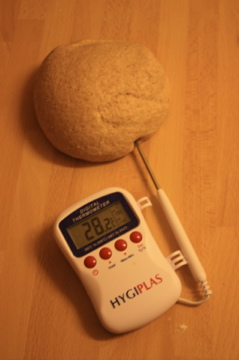

At this stage I must mention timings, bread can be made from scratch and baked after an hours proofing, shaping and re-rising, but the point of proofing or fermentation is to get the culture working within the dough. The natural sugars in the flour act as food for the yeast and the aim is to extract as much flavor from the rather special flour that we are using. The length of fermentation time is therefore important as is temperature. Bakeries have special proving cabinets which are set to automatically change temperature at certain times to get the perfect time-temperature equilibrium in order to get the best results from the dough. What Mr. Reinhart suggests is, in a domestic setting, to use the fridge and rest the dough overnight, while it is a long ferment the cool temperature 'retards' the bacterial action allowing for a full flavor at the same time fitting into a normal lifestyle.


So into a lightly oiled bowl covered and into the fridge over night. I actually left mine until I came home from work the following evening then shaped it onto a baking tray lined with parchment and left for another 3 hours to get to room temperature and start the second ferment.


Having scored it, which aids any extra expansion that happens once it hits the heat, it goes into an oven at 200C for about 40 minutes.


Having spent fifteen minutes with floury hands on Thursday night I was able to enjoy this loaf all weekend. While it was slightly flatter than I had hoped the loaf had a fragrant nutty aroma and dense and chewy crumb.


Thanks to
Sharpham Park for the flour.

Brewed Boy Coffee

Brewed Boy's coffee cart arrives at seven every morning at one of the last remaining seedy corners of Soho. Twilight's, Little Amsterdam and a miscellaneous latex-wear shop not yet open for business line the quiet cobbled street as Rob Lockyear (AKA Brewed Boy) sets up his stall ready for the morning rush.

I came across Rob quite by accident on a sunny morning while out on errands; needing a caffeine fix I got chatting to the extremely personable and well-spoken Rob whilst enjoying the best flat white (read Aussie Cappuccino) I'd ever had.

Coffee is huge business these days. Corporate giants make millions; chain operators are inescapable on every high street, train station and airport. Costa Coffee concessions are found in gyms, pubs, hostels and the list goes on. This wouldn't be a problem if the coffee was tasty and keenly priced. Unfortunately as a population we have become accustomed to towering Grandes of milky pond-water that gives little change in exchange for a fiver. The Coffee served by Brewed Boy on the other-hand is something totally different. He describes it as an 'affordable daily luxury', micro-foam milk heated with a deft touch, poured over an oily and aromatic shot of mahogany coffee. Smooth and sweet, with hints of wood and hay hit the nose before the silky slick is swallowed down. Not only does this morning fix hit the spot like no other high street jolt it costs the same but made will care and attention and a personal edge. In terms of value for money this product is second to none.


Rob Lockyear became a Barista having spent time in the new-wave c
offee centre of the world, Australia. Barista's in Australia are held in extremely high regard, trainees are often not even allowed to touch the hallowed machines for up to three months after starting work in a cafe. Intensive training is important to the education of a proper Barista. This is in stark contrast to the one-day training programme your average coffee shop employee undergoes whilst being taught how to use the one-button-push bean-to-cup super-auto machines designed specifically to dehumanise the coffee making process.

Good training is not the only secret to Brewed Boy's process, he remarks that "I talk to the same people every day who come down buy their coffee from me, it's almost as if the coffee is secondary. People love it when you know them by name and can remember their order. I have a list of regulars who I see every day, I hardly ever make money from tourists."

The human aspect of Rob's vocation seems to be so important. Each weekday morning starts with the wheeling of the coffee cart from the lock-up 100 meters from the Rupert Street site. As no plumbing exists for the mobile unit, Rob has made fiends with local businesses who give him water to fill the boiler of the machine. He says that: "At first the guys were quite suspicious, thinking I was up to something but as soon as they get to know your face they really start to help you out. This goes for letting me use their toilets too."

After an initial set up and half an hour waiting for the machine's water boiler to heat up the cart is set for action. Between 9 and 10 am is the 'power hour' when Rob really shifts his product; recently he has even taken on another pair of hands to help out with this manic session.

Rob sometimes complains of the early starts in the depths of winter with the driving rain and harsh cold, "sometimes I think what am I doing? Especially when you've got drunks and drug dealers always trying to rip you off or get money out of you, sometimes the Police come down and make arrests right in front of the cart, I just wish it would all go away, but there are the great days and I wouldn't change it for the world."

With a keen eye on the future Rob can see a general heightened awareness of those who care much more about what they eat and drink. Increasing demand for higher quality and specialisation of products is a trend that will continue to move forward at pace. When asked where he envisages himself in a few years time Rob answers: "I'd like to move off the street into somewhere more permanent and become more established. A cafĂ© bar where we serve simple but really high quality food and drink. A place where people can come and hang out. The offering will the limited but amazing, I want to push things forward”.

Rob Lockyear
m: 07552591125
e: rob.lockyear@gmail.com
t: twitter.com/brewedboy